
How to Improve Couples Communication: 7 Exercises That Work
Discover 7 proven couples communication exercises that strengthen your bond and resolve conflict — starting tonight.

How to Improve Couples Communication: 7 Exercises That Work
Good couples communication isn't something you either have or you don't — it's a skill. And like any skill, it gets better with practice.
Whether you're navigating a rough patch, feeling disconnected, or simply want to go deeper with your partner, the right couples communication exercises can make a measurable difference. Not someday. Tonight.
In this guide, you'll find 7 evidence-backed exercises that actually work — plus practical couples communication tips to help you build the habit long-term.
Why Couples Communication Breaks Down
Before the exercises, it helps to understand what goes wrong.
Most communication problems in relationships aren't about what partners say — they're about how they say it, and when.
The Gottman Institute found that the ratio of positive to negative interactions during conflict (the "5:1 ratio") predicts relationship stability more accurately than the frequency or intensity of conflict itself (Gottman & Silver, The Seven Principles for Making Marriage Work, 1999).
According to Dr. John Gottman's research, approximately 69% of relationship conflicts are perpetual — they never fully resolve because they're rooted in fundamental personality or lifestyle differences. The goal isn't to eliminate these conflicts, but to learn to dialogue about them constructively.
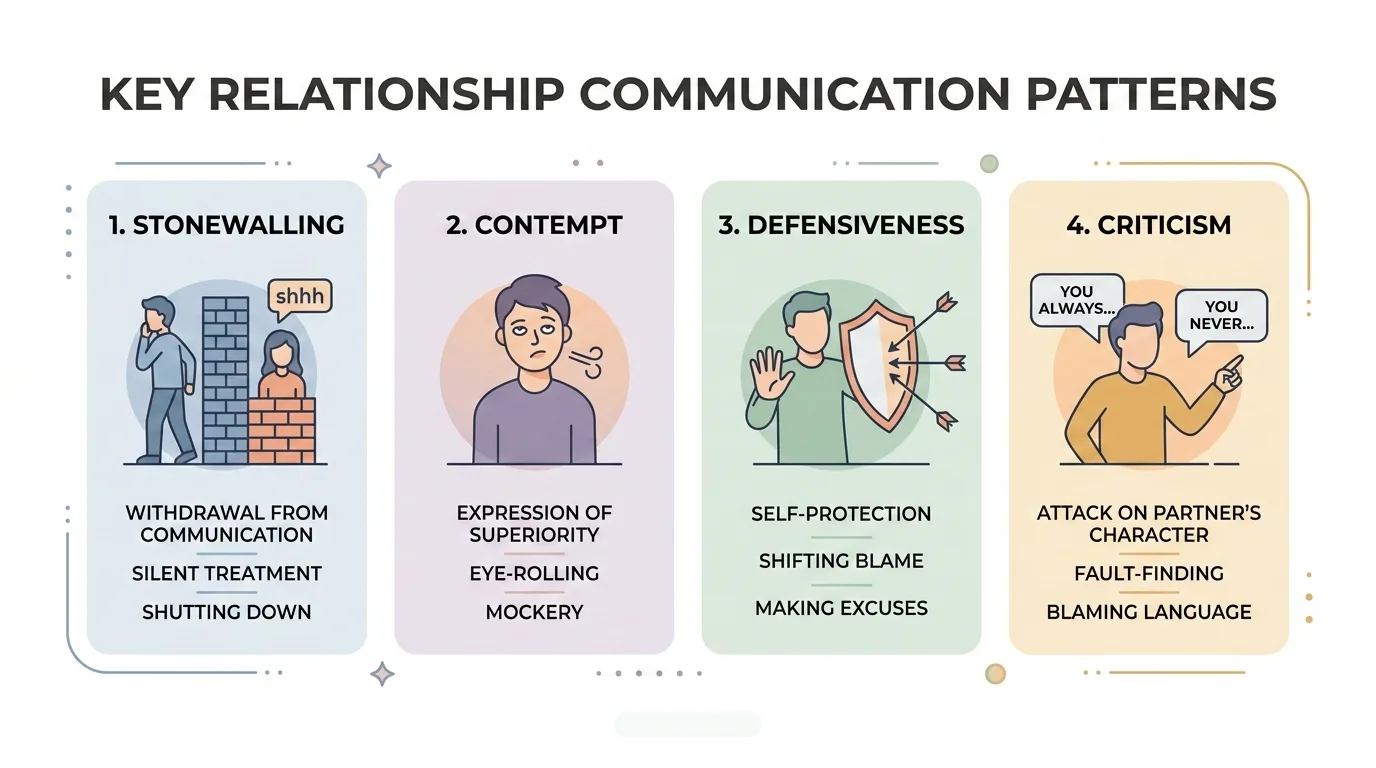
Common patterns that silently erode couples communication skills:
- Stonewalling — shutting down instead of engaging
- Contempt — eye-rolls, sarcasm, dismissiveness
- Defensiveness — deflecting instead of listening
- Criticism — attacking character, not behavior
Understanding your communication styles as a couple is the first step — are you more avoidant, confrontational, or passive? Once you recognize your default patterns, the exercises below become far more effective.
The good news: all of these are reversible with intentional practice.
If conflict tends to escalate quickly, it helps to learn how to fight fair in a relationship before small disagreements turn into repeating damage.
7 Couples Communication Exercises That Actually Work
1. The 5-Minute Daily Check-In
What it is: A short, structured daily conversation with a fixed format.
How it works: Each partner takes 2.5 minutes to share:
- One thing that was hard today
- One thing they're grateful for
- One thing they need from the other
No advice-giving allowed. Just listening.
Why it works: Consistency beats intensity. According to research from the Gottman Institute, a 5-minute daily habit builds more trust than a 3-hour annual conversation.
Couples communication tip: Do it at the same time each day — right after dinner or just before bed works well for most couples.
2. Mirroring
What it is: Reflecting back exactly what your partner said before responding.
How it works: Partner A shares something on their mind. Partner B responds only with: "What I'm hearing you say is… Is that right?"
Only after A confirms does B share their own perspective.
Why it works: Most arguments happen because both people are waiting to talk, not actually listening. Mirroring forces real attention. A study published in the Journal of Marriage and Family found that couples who practice active listening techniques report up to 50% improvement in relationship satisfaction within weeks.
Skill built: Active listening — the cornerstone of couples communication skills.
3. The Appreciation Exchange
What it is: A daily ritual of expressing specific appreciation for your partner.
How it works: Each day, tell your partner one specific thing you appreciate — not "I appreciate you" but "I appreciated that you made coffee this morning without being asked, it made me feel cared for."
Why it works: Specificity makes appreciation land. Vague compliments are easy to dismiss; specific ones build genuine emotional connection.

4. Structured Problem-Solving (The "Speaker-Listener" Technique)
What it is: A formal turn-taking framework for difficult conversations.
How it works:
- One partner holds an object (a "talking piece") — only they can speak
- The speaker uses "I" statements only
- The listener summarizes before taking the talking piece
- Switch roles after each summary
Why it works: When emotions run high, structure keeps conversations from escalating. This is one of the most-used couples communication activities in couples therapy. If you're exploring whether therapy is the right step, read our guide on couples therapy alternatives.
5. The Weekly Relationship Review
What it is: A 20-minute weekly check-in covering the relationship as a whole.
Template to follow:
- What went well this week between us?
- What felt hard or disconnected?
- One thing I'd like more of next week
- One thing I'd like to work on in myself
Why it works: Small issues get addressed before they compound. This is especially effective for couples who feel "stuck in autopilot."
6. Emotion Mapping
What it is: Learning to identify and name emotions more precisely before communicating them.
How it works: Before a difficult conversation, each partner independently writes down:
- What they're feeling (using an emotion wheel to go beyond "angry" or "sad")
- What they need as a result of that feeling
- What they're asking from their partner
Why it works: Most couples argue about the surface issue when the real issue is an unmet need. Emotion mapping brings the real conversation forward.
Couples communication tip: Keep an emotion wheel (easily found online) pinned somewhere visible at home.
7. Technology-Assisted Check-Ins
What it is: Using a guided app to prompt meaningful conversations consistently.
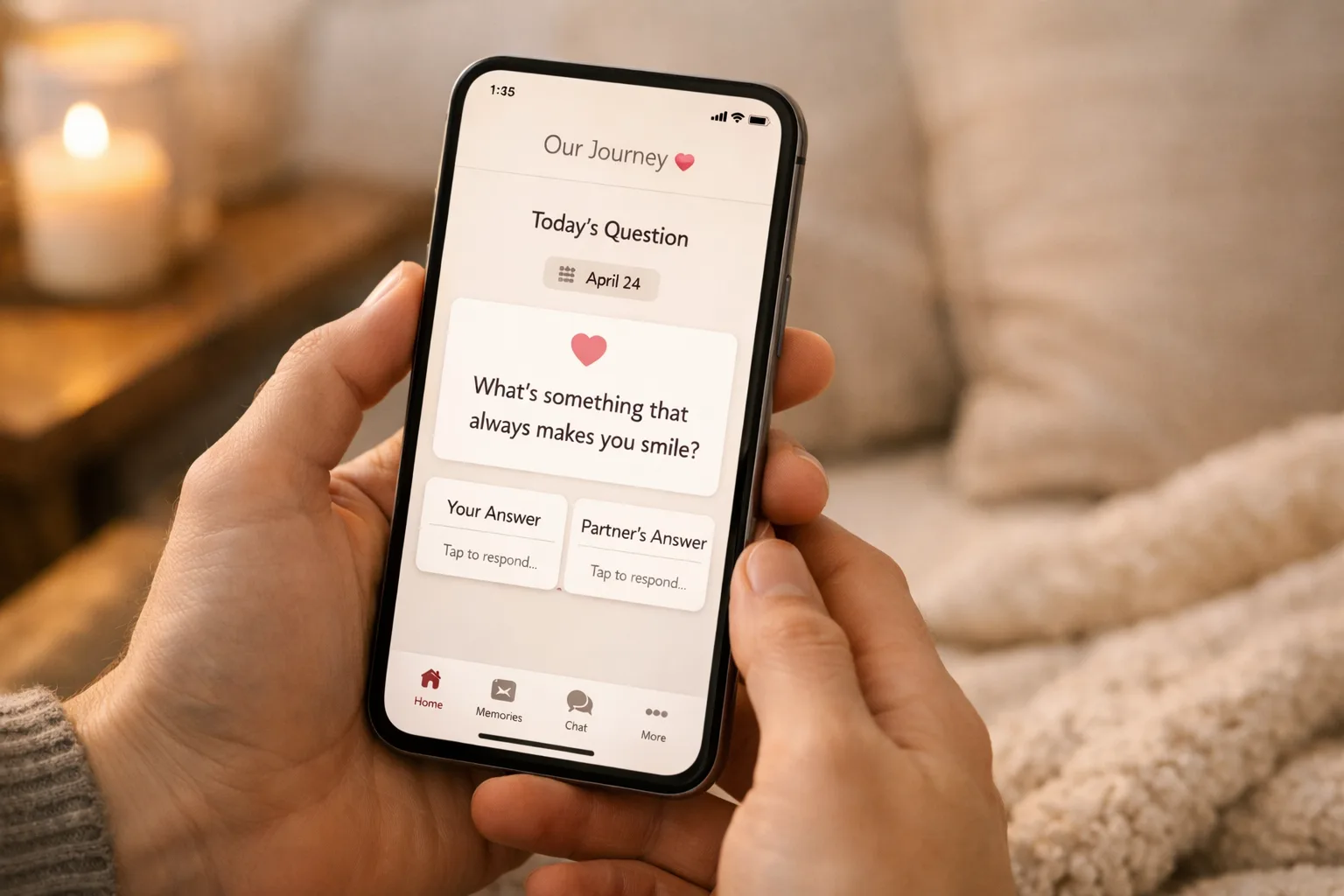
How it works: Apps like Listening Loft send daily prompts, guided reflections, and structured check-in questions designed specifically for couples. Instead of staring at each other wondering what to talk about, you have a starting point — every day.
Why it works: The biggest obstacle to good couples communication isn't willingness — it's friction. When the question is already prepared and the structure is built in, couples are dramatically more likely to actually have the conversation.
How to Build a Long-Term Communication Habit
Exercises are the beginning. Habits are the goal.
Here's what works for couples who actually improve their communication over time:
Start small. One exercise. Five minutes. Three days a week. Not a complete overhaul.
Make it mutual. Both partners need to opt in. If one person is forcing the other, it won't stick.
Repair fast. When a conversation goes sideways (it will), the goal isn't to avoid conflict — it's to repair quickly. Dr. John Gottman's research shows that the ability to make and accept repair attempts is one of the strongest predictors of relationship success. A simple "I don't like how that went, can we try again?" is a powerful couples communication skill. For more on what research says about healthy conflict, see our guide on relationship advice that actually works.
Track progress. Not obsessively — but noticing when things feel better reinforces the habit. This is where a tool like Listening Loft helps: it creates a gentle log of your connection over time.
Sources & Further Reading
- Gottman, J. & Silver, N. — The Seven Principles for Making Marriage Work (1999)
- Gottman, J. — What Makes Love Last? (2012)
- Markman, H., Stanley, S. & Blumberg, S. — Fighting for Your Marriage (2010)
- The Gottman Institute — gottman.com
- American Psychological Association — "What Works in Couples Therapy"
Common Questions About Couples Communication
How long does it take to improve couples communication?
Most couples notice a difference within 2–3 weeks of daily practice. Deeper patterns (like defensiveness or stonewalling) take longer — typically 2–3 months of consistent effort.
What if my partner doesn't want to do exercises?
Start with the lowest-friction option: the daily appreciation exchange. It doesn't feel like an "exercise" — it just feels good. Once momentum builds, your partner is more likely to engage further.
Are couples communication activities only for couples in crisis?
Not at all. The strongest couples are often the ones who proactively invest in communication — not the ones who wait until there's a problem.
Can an app really help couples communicate better?
Yes — when the app is designed for depth rather than distraction. Listening Loft was built specifically around structured reflection and guided conversation, not gamification or streaks.
The Bottom Line
Couples communication is a practice, not a destination. The couples who thrive aren't the ones who never argue — they're the ones who keep showing up for the conversation.
Pick one exercise from this list. Try it tonight. See what happens.
And if you want a daily structure built for exactly this, try Listening Loft for free — your relationship's daily check-in, whenever you're ready.
Ready to Grow Together?
Start your free couples check-in — no judgment, no pressure, just a warm space to understand each other better.